
Most traders track their P&L obsessively and their process not at all. That's backwards. Your account balance tells you what happened. A report card tells you why, and why is the only thing you can actually fix.
If you've ever ended a red week with a vague sense that you traded badly but couldn't say exactly what went wrong, this is the habit that closes that gap. A trading report card is a structured self-review you write at the end of a reporting period (a day, a week, or a month) where you reflect on what you did right, name what you did wrong, and lock in a couple of specific improvements for the next period. Do it consistently and the small corrections compound into real, durable consistency.
Why P&L Alone Won't Make You Better
Here's the trap I fell into for years. I judged every session by the number at the bottom. Green day, good trader. Red day, bad trader. The problem is that the market pays you for the wrong things all the time. You can break every rule in your plan and still get bailed out by a runner. You can trade a flawless process and still lose. If your only feedback signal is P&L, you're training yourself on noise.
A report card fixes this by separating decision quality from outcome. When I scalp TSLA or short-dated NVDA, some of my best-executed trades are losers and some of my sloppiest are winners. If I only reviewed the winners, I'd be reinforcing the exact behavior that blows up accounts. Grading the process, meaning did I follow my plan, size correctly, honor my stop, wait for my setup, is what compounds into an edge.
The most common report card mistake is grading yourself on P&L. A disciplined red day can be a good day. A reckless green day is a warning sign. Judge the decisions, not the dollars. Outcome is variance. Process is edge.
Report Cards Are Reporting Periods, Not Just Diary Entries
The system that actually works runs on three separate reporting periods, each doing a different job.
Daily catches your in-the-moment execution while it's still fresh: the revenge trade, the setup you forced out of boredom, the profit you gave back in the last hour. Weekly zooms out to spot patterns across days that no single session reveals, like the Friday-afternoon giveback, the slow start every Monday, or the fact that your best days all began with real pre-market prep. Monthly is the strategic layer. Over a month you have enough trades to ask the bigger questions: is my edge holding up over a real sample, which setups are actually earning their size, and what structural change do I make going into next month?
These aren't nested roll-ups where one folds into the next. Each is its own reflection at its own time scale, and each ends the same way, with a short list of concrete goals to carry into the next period.
The Method: How to Write a Report Card That Changes Your Trading
Whatever the period, a strong report card moves through four parts. This is the exact structure I use, and it's built into how the review flows.
1. Snapshot the period honestly
Start with a plain-language summary of what actually happened, not just the net number but the story behind it. "Finished +$82 net across 19 trades at a 42% win rate. Was up $227 before giving back half on my last three trades around 11:00 AM." That one sentence already tells you where the lesson lives. The number is the headline. The shape of the day is the story.
2. Write down what you were trying to do
Before you grade execution, state the trading plan you came in with. "I focused on TSLA scalps. It was in an inside-day pattern for three days, so I wanted tight range trades and quick exits at key levels." You can't judge whether you executed well if you never wrote down what "well" was supposed to look like. This step keeps your review anchored to intent instead of to the P&L.
3. Name what worked
List the things you did right, and be as specific here as you are about the mistakes. "I stuck to one underlying instead of hunting across symbols. I scaled in thirds on my best setups. I took quick profits on winners." Most traders skip this and only catalog failures, which is a fast way to erode confidence and miss the behaviors worth reinforcing. What worked is data too.
4. Decide what you'll improve, and turn it into 2-3 goals
This is the engine of the whole system. Identify where you slipped (chased a break at a reversal time, sized up out of FOMO, gave back profit on tired late trades) and convert each into a specific, checkable goal for the next period. Not five goals. Two or three you can actually hold yourself to:
- "I will avoid chasing low-of-day breaks at reversal times. Wait for confirmation on the next bar."
- "I will cut size or stop trading TSLA when the broader market is breaking out of its own range."
The discipline is in the constraint. Two concrete goals you honor beat ten aspirations you forget by Tuesday. Pick a small number of improvements each period, carry them into the next one, and let the corrections stack. That repeated loop is what separates traders who plateau from traders who compound.
Keep Prop and Retail Accounts Separate
One structural point that trips traders up: if you trade both funded or prop accounts and a personal retail account, review them separately. They're different games. A $60 winning day on a small retail account and a $12,000 day across twenty funded accounts don't belong in the same reflection. The risk, the sizing, the psychology, and the evaluation rules are all different.
Blending prop and retail reviews muddies every lesson you'd otherwise pull out. Keep one report card per context. When something genuinely carries over between them, reference it, but don't average two different games into one number.
In MyPropJournal you choose prop or retail right when you create the card, so each review stays true to how that account is actually traded.
Where Report Cards Fit in Your Trading Workflow
A report card isn't a standalone document. It's the last step in a loop that runs through your whole trading day, and understanding where it sits makes the review faster and a lot more honest.
For a day trader, it usually goes like this. You start the session with your session notes: your pre-market plan, your read on the intermarket picture, quick notes through the day, maybe a lunch-hour check-in and a closing note. That running record captures your actual thought process in real time, before hindsight rewrites it. When you sit down to write your daily report card, you read back through those session notes to reconstruct what you were genuinely thinking at each decision, not what you wish you'd been thinking.
Then there are the individual trades. If you ran a trade review on a couple of executions, or wrote up your best trade and your worst trade of the day, you can link those directly to the report card. Now your entries and exits are one click away while you reflect, so "I chased that break" is backed by the actual trade, the actual chart, and the note you wrote at the time.
That's the loop. Session notes capture the day as it happens, trade reviews and write-ups dissect the individual decisions, and the report card pulls it all together into a verdict and a set of goals for next time. Each piece feeds the next, which is why the review gets easier the more of the workflow you actually use.
How MyPropJournal Handles Report Cards
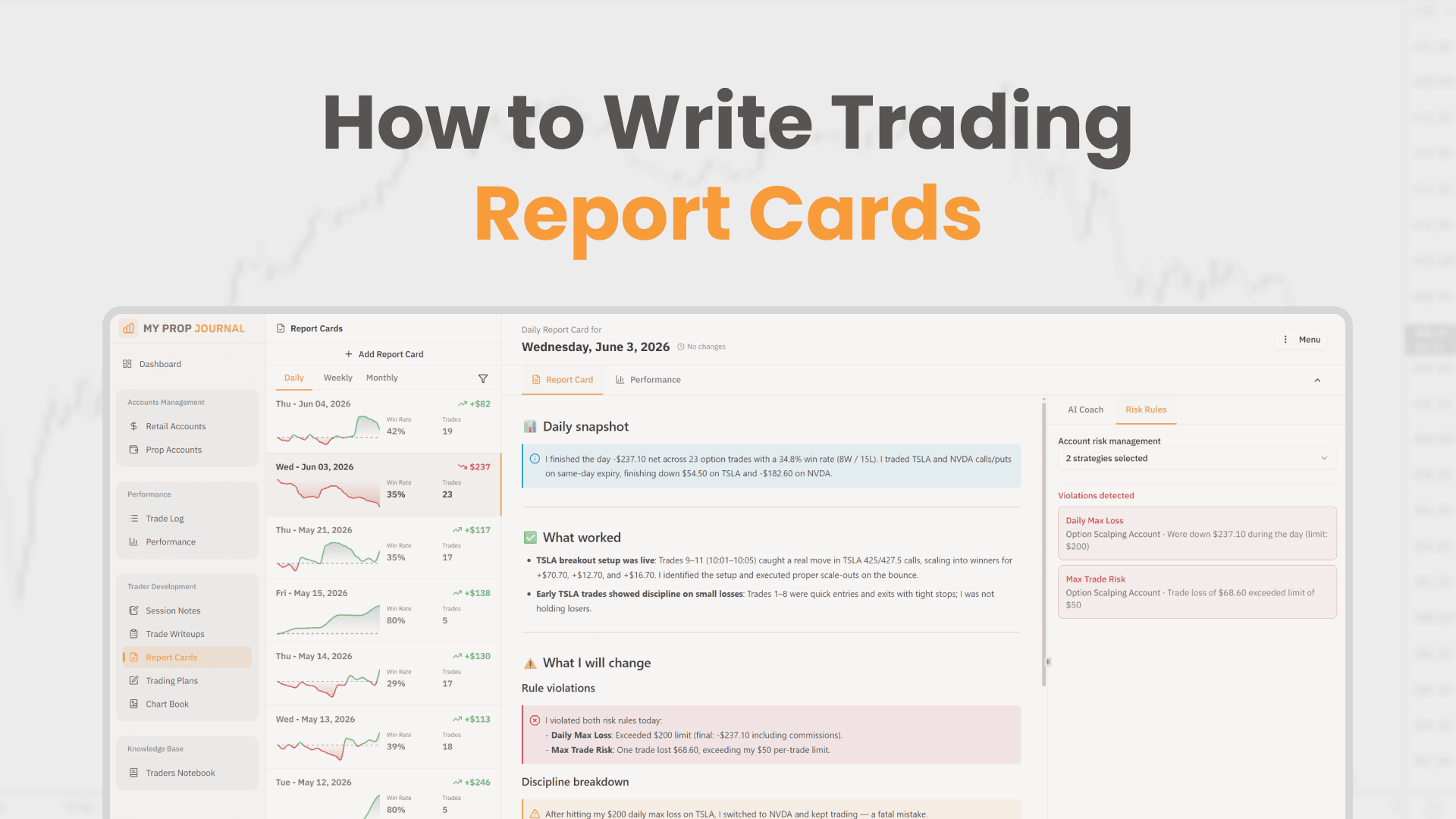
I built report cards into MyPropJournal because I was doing this in a notebook and constantly losing the thread between my trades and my reviews. In the app, you pick a period (Daily, Weekly, or Monthly) and the card sits right alongside the trades it's grading. Each period type has its own tab, so your daily reflections and your monthly strategic reviews never blur together.
Two things make the review actually useful instead of just tidy. First, every card has a Performance tab that pulls the hard numbers for that exact period: win rate, average win versus average loss, profit factor, hold times, P&L by symbol, and the full trade list. Your written reflection and your real stats sit side by side, so when you write "I gave back profit on my last three trades," the data is right there to confirm it.
Second, if you've set up risk management rules on an account (max daily loss, max trade risk, and so on) the card automatically flags which rules you followed and which you violated for that period. That turns "did I stay disciplined?" from a gut feeling into a checked box.
Keep the card fast. A five-minute review you actually do every period beats a thorough one you abandon after a week. When you're done, you can save it as a reusable template, download it as a PDF, or generate a shareable link to send it straight to a mentor or trading group.
Common Report Card Mistakes to Avoid
- Grading on P&L. The single most common mistake. If green always equals a good grade, you're reinforcing outcome, not process.
- Only reviewing bad days. Your winning days hide just as many bad habits. They just didn't cost you this time.
- Blending prop and retail. Different risk, different sizing, different rules. Separate reviews, separate lessons.
- Making the card too long. A short card you do consistently beats a detailed one you quit.
- Setting too many goals. Two or three specific improvements compound. A list of ten is noise you'll ignore.
- Never closing the loop. If you never turn a pattern into an adjustment, you're documenting your mistakes, not fixing them.
Start Grading Your Trading
The traders who get consistent aren't the ones with the best entries. They're the ones with the tightest feedback loop between a decision and the next one. A report card is how you build that loop, at whatever cadence fits your trading, and it costs you a few minutes per period.
You can start with a notebook today. But if you want your report cards sitting right next to the trades they're grading, with daily, weekly, and monthly periods, automatic risk-rule checks, and full performance stats for each period in one place, that's exactly what MyPropJournal is built for.
Start your 14-day free trial and write your first report card tonight.